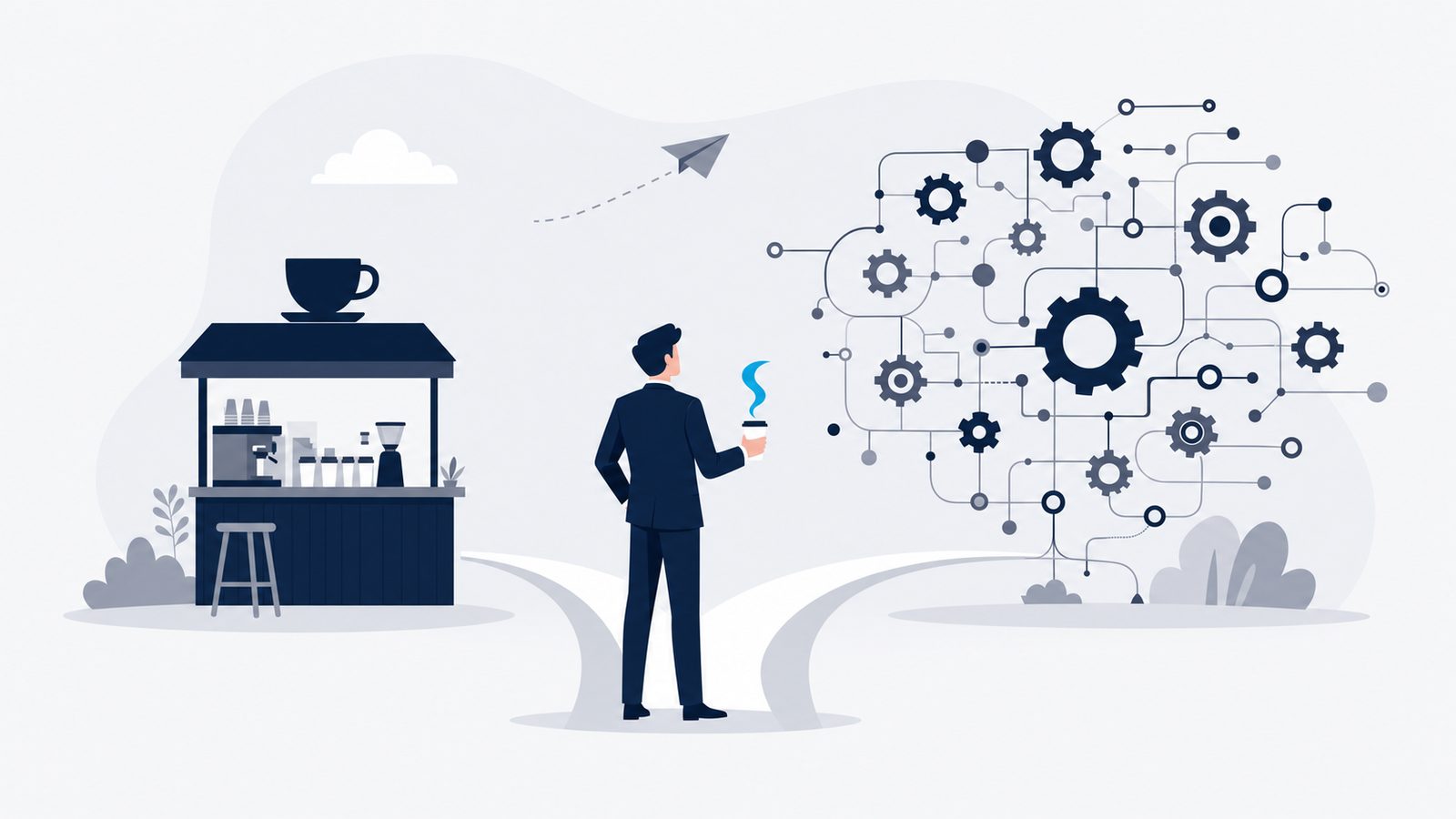
Understand the difference between complex and complicated challenges in business growth through the lens of a neighborhood coffee shop and the global giant, Starbucks.
Leaders face various challenges as they guide their organizations toward growth and success. Some are complicated, requiring technical expertise and systematic solutions, while others are complex and demand adaptability, creativity, and resilience. Understanding the difference between complicatedness and complexity is essential for business leaders to develop the right strategies for their unique challenges. This article explores these concepts by comparing two different types of coffee businesses: a neighborhood coffee shop and a global coffee giant.
We’ll explore how these businesses navigate their challenges and illustrate the key differences between complicated and complex growth strategies. The goal is to offer insights that help leaders apply the right approach to their business growth, whether they’re running a small business or managing a global corporation.
The Difference Between Complicated and Complex Challenges
Before diving into the stories, it’s essential to establish what we mean by complicated and complex challenges.
Complicated challenges involve many parts, but these parts follow a predictable pattern. Through specialized knowledge, the challenges can be broken down, analyzed, and solved systematically. Examples of complicated challenges include building a car or managing a supply chain. Each step requires expertise, but it can be repeated and controlled once mastered.
Complex challenges, on the other hand, are characterized by unpredictability. The parts in a complex challenge interact dynamically, leading to outcomes that can’t always be predicted or controlled. Complex challenges include ecosystems, organizational culture, and global markets. In these cases, the challenge isn’t just about having the right knowledge but also about being adaptable, creative, and responsive to change.
In complicated challenges, the focus is on efficiency, optimization, and process mastery. In complex challenges, the focus shifts toward flexibility, resilience, and the ability to respond to unexpected outcomes.
Let’s compare the growth journeys of a neighborhood coffee shop and Starbucks to see how these concepts play out in the real world of business.
Café Terra: Embracing Complexity
Meet Maria, the owner of Café Terra, a cozy neighborhood coffee shop with a loyal customer base. Café Terra is known for its unique, carefully crafted coffee blends from small, sustainable farms worldwide. Maria’s attention to detail and passion for coffee have created a strong community around her shop. But as Café Terra gains popularity, Maria starts considering her next steps—should she expand? Should she open a second location or even franchise her brand? What started as a relatively simple business model has now become a more complex challenge.
Brand Design: Navigating Uncertainty
One of Maria's first challenges is scaling her brand without losing the essence of what makes Café Terra special. Her shop has an intimate, community-focused atmosphere, and her customers love the personal touch she brings to the experience. But how does that translate to multiple locations?
Maria must decide how to maintain the integrity of her brand while expanding. Should she keep the artisanal feel or tweak it to appeal to a broader audience? How will her brand evolve as it scales, and how will it remain consistent across different locations?
This challenge exemplifies complexity because there are no clear-cut answers. Every decision Maria makes about her brand will have ripple effects. The customer base in a new location might have different preferences. Competitors in other areas could push her to adapt her branding. This is the essence of a complex challenge—Maria can’t predict the outcome of her decisions with certainty, and she must be willing to experiment, adapt, and pivot as she expands her brand.
Menu Innovation: Balancing Consistency and Creativity
Another area where Maria faces complexity is in her menu. Café Terra is known for its rotating menu of seasonal coffee blends and pastries made in-house. This level of innovation keeps her customers excited and coming back for more. But as she considers opening new locations, Maria faces a dilemma—how can she keep the menu fresh and exciting while maintaining consistency across different shops?
In a single location, Maria can experiment freely. She can respond to customer feedback quickly and introduce new items based on what’s in season or what inspires her. But as she scales, this becomes more challenging. If she has multiple locations, customers will expect a certain level of consistency in the menu, but too much consistency might stifle the creativity that made her shop popular in the first place.
This is another example of complexity—there are many interacting factors, and the outcomes are unpredictable. Maria must balance the need for consistency with the need to innovate, and she must remain adaptable to the preferences of customers in different markets.
Business Model: Exploring New Opportunities
As Maria explores different growth opportunities, she encounters another layer of complexity. Should she open a second location herself, or should she consider franchising her brand? Each option comes with its own set of risks and uncertainties.
Licensing and Franchising: If Maria chooses to franchise Café Terra, she must navigate the complexities of maintaining quality control and brand consistency across franchisees. Franchisees may not have the same level of passion or commitment to the brand, and Maria will need to establish clear guidelines to ensure that each new location upholds her high standards.
Full Ownership: On the other hand, if Maria chooses to own each new location herself, she faces the challenge of managing multiple shops. This brings new complexities in terms of staffing, supply chain management, and operational oversight.
In either case, Maria is navigating a web of interconnected decisions, each with its own risks and opportunities. There’s no single right answer, and the outcome will depend on how well Maria adapts to the challenges and unknowns that arise as she grows her business.
Starbucks: Mastering Complicatedness
Now, let’s shift gears and look at Starbucks, one of the largest coffee chains in the world. Starbucks operates thousands of locations across the globe, serving millions of customers every day. While the scale of Starbucks is massive, the company excels at managing complicated challenges.
Standardized Processes and Procedures
One of the keys to Starbucks’ success is its ability to replicate its processes and procedures across thousands of locations. From how the drinks are made to how the stores are laid out, everything at Starbucks follows a predictable, standardized process. These processes ensure that customers have a consistent experience, whether they’re in New York, Tokyo, or Paris.
This level of standardization is what makes Starbucks a complicated challenge. There are many moving parts—supply chains, employee training, store design, and customer service—but because these parts follow established procedures, they can be managed systematically. The challenge for Starbucks isn’t about adapting to unknowns; it’s about refining and optimizing the systems they’ve already built.
When Starbucks opens a new store, they follow a well-defined process: conducting market analysis, selecting a location, designing the store, hiring and training staff, and launching the store. While each new store requires effort, the steps are known, and Starbucks can replicate them with precision.
Supply Chain Management: Handling Intricacies
Starbucks’ supply chain is another example of a complicated challenge. The company sources coffee beans from various regions around the world, manages relationships with farmers, and ensures that these beans are delivered to thousands of stores. This supply chain is intricate and involves many players, but because it follows a predictable pattern, Starbucks can manage it through careful planning, logistics, and optimization.
The focus here is on expertise—Starbucks knows how to manage a global supply chain, and they’ve built capacity by refining each step of the process. This allows them to scale their operations predictably and efficiently.
Employee Training: Maintaining Consistency
Training employees at Starbucks is another example of how the company manages complicated challenges. Every barista follows the same training program, ensuring that they can deliver the same quality of service no matter where they are located. Starbucks invests heavily in training and development to ensure that every customer receives a consistent experience.
Again, this is complicatedness in action—the training process is standardized, and once mastered, it can be repeated across thousands of locations. The challenge for Starbucks is about optimizing this process to ensure efficiency and consistency.
The Contrast Between Complexity and Complicatedness
The stories of Café Terra and Starbucks illustrate the fundamental differences between complexity and complicatedness in business growth.
Café Terra faces complexity as it expands. Maria’s challenges are unpredictable and interconnected, requiring her to adapt, innovate, and remain flexible in the face of uncertainty. Her success depends on her ability to navigate a web of decisions that will have dynamic and emergent outcomes.
Starbucks operates in a world of complicatedness. The company’s challenges are intricate but predictable, allowing them to solve problems through expertise and systematic processes. Their success lies in refining and optimizing their systems, ensuring that they can replicate their business model at scale.
While both businesses face challenges, the nature of these challenges is fundamentally different. Café Terra must build capacity by fostering creativity, resilience, and adaptability, while Starbucks builds capacity through expertise, precision, and optimization.
Applying These Lessons to Your Business
Understanding the difference between complexity and complicatedness can help business leaders apply the right strategies to their own growth challenges. Here are some key takeaways:
Identify the Nature of Your Challenges: Are the challenges you’re facing predictable or unpredictable? Are they interconnected with dynamic outcomes, or can they be solved through expertise and systematic processes? Identifying the nature of your challenges will help you determine whether you’re dealing with complexity or complicatedness.
Build Capacity Accordingly: If you’re dealing with complexity, focus on building flexibility, resilience, and adaptability. Encourage innovation, foster collaboration, and be prepared to pivot when things don’t go as planned. On the other hand, if you’re dealing with complicatedness, focus on building expertise, refining processes, and optimizing efficiency.
Balance Creativity and Consistency: In some cases, you may face a mix of complexity and complicatedness. For example, you may need to maintain consistency in certain aspects of your business while also encouraging creativity and innovation in others. Finding the right balance between these approaches is key to achieving long-term success.
Embrace Uncertainty: If you’re dealing with complexity, recognize that uncertainty is part of the process. Embrace it as an opportunity for growth and learning. Be open to experimentation and iteration, and don’t be afraid to adjust your course as new information emerges.
Refine Your Systems: If you’re dealing with complicatedness, focus on refining and optimizing your systems. Look for ways to improve efficiency, reduce waste, and streamline processes. The more you can fine-tune your systems, the better equipped you’ll be to scale your business effectively.
Leaders must navigate both complexity and complicatedness as they guide their organizations toward growth. By understanding the differences between these two types of challenges and building the right capacity to manage them, leaders can position their businesses for long-term success.
Whether you’re running a small coffee shop like Café Terra or managing a global brand like Starbucks, the key is to approach your challenges with the right mindset. In a world of complexity, embrace adaptability, creativity, and resilience. In a world of complicatedness, focus on expertise, precision, and optimization. By mastering both approaches, you’ll be better equipped to navigate the unpredictable journey of business growth.
About Anker Bioss
Anker Bioss is a global leader in helping organizations unlock their human potential by developing confidence in decision-making and delivering strategic capabilities. Leveraging a deep understanding of talent dynamics, leadership development, and organizational complexity, Anker Bioss provides innovative tools and insights to help clients navigate uncertainty, optimize performance, and achieve sustainable growth in an ever-evolving business landscape.